Reload, shield, shoot: the rules and how to win
Strategy · · 4 min read
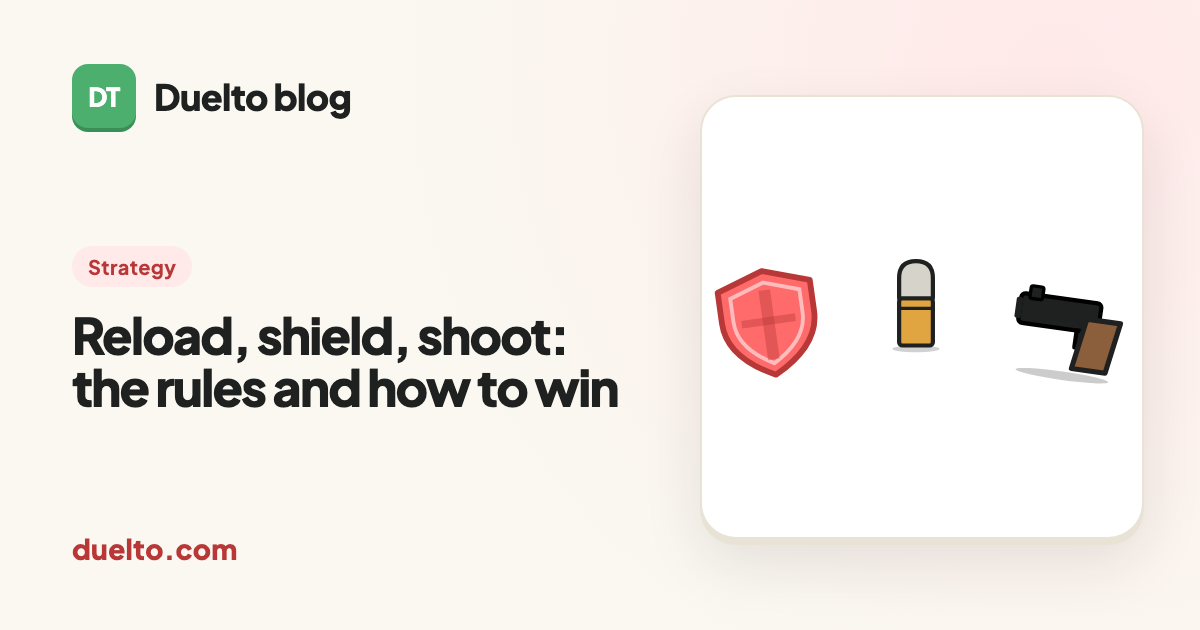
Plenty of people played some version of this at school: two players facing each other, clapping a rhythm, and on the beat each one reloads, blocks or fires an imaginary gun. It goes by different names in different playgrounds, and nobody wrote down a standard set of rules.
It looks like rock paper scissors with three new signs, but it is not. Here your moves have a memory — the bullets you load stay loaded — and that turns a guessing game into one you can actually plan.
The rules
Each round both players choose one of three moves at the same moment:
- Reload: add one bullet to your gun.
- Shield: block anything fired at you this round.
- Fire: spend one bullet. It hits unless the other player is shielding. With no bullet loaded, nothing happens.
The rules on Duelto
Playground versions differ on the details — how many bullets you can hold, whether one hit ends it. In BattleShield they are fixed:
- Both players start with an empty gun and can hold at most five bullets.
- Both players can see how many bullets the other has loaded.
- If both fire and neither shields, both hits count.
- The first to five hits wins the match. If both reach five in the same round, it is a draw.
- You have ten seconds to choose; if you do not, your shield goes up by itself.
Why it is not rock paper scissors
In rock paper scissors every round starts from nothing, and no sign is better than another. Here the round before changes the one after. A player with no bullets cannot hurt you. A player with five cannot load any more. Every move either builds up a threat or spends one, and both of you can see the count.
So the question each round is not “what will they pick?” out of thin air, but “what can they do, and what do they need to do?” — and that has an answer much more often.
Count their bullets
The single most useful habit is to look at the other player’s bullets before you choose:
- They have none: they cannot hit you this round, so a shield is a wasted move. Reload, or fire if you think they will reload.
- They have one or two: they can hurt you, but they also want to build up. Mixed rounds — this is where reading the person starts.
- They have five: they cannot load more, so every round they do not fire is a round they gain nothing. The shot is coming; the only question is when.
The first round
Both guns start empty, so on round one nobody can be hit. Shielding protects you from nothing and firing does nothing. Reloading is simply the best move, and a player who does anything else has given you a free bullet’s lead.
When to reload, when to fire
Reloading is safe when the other player is not going to fire — because they have no bullets, or because you expect them to shield. Firing pays when you expect them to reload, since a reload leaves them open.
That creates the core tension. The moment you reload is exactly the moment your opponent would most like to fire. A player who reloads on a regular rhythm — every time they have just fired, say — gets shot. Vary it.
Shielding is a tempo cost
A shield never scores and never loads. It only buys a round. Raise it when a shot is likely — an opponent with a full gun, or one who has just watched you reload twice — and not as a reflex. A player who shields too often falls behind on bullets and ends up having to reload into the other player’s shots.
A plan for a match to five
Putting it together:
- Round one: reload.
- Before every choice, check both bullet counts. Theirs tells you whether you can be hit; yours tells you whether you can threaten.
- Build a bullet or two of lead before you start firing, so a blocked shot does not leave you empty.
- Fire when you expect a reload, shield when you expect a shot, and do not let either become a pattern.
- Near the end, count the hits too: if both of you are at four and both have bullets, a mutual shot is a draw, not a win.
The same reading, three ways
The skill underneath is the one from how to win at rock paper scissors: people are not random, and the way they react to what just happened shows. BattleShield adds a resource to count; RPS Board adds hidden pieces on a board. All three are quick one-on-one duels against a real person.