Sea Battle: a game older than any box it came in
Classic games · · 4 min read
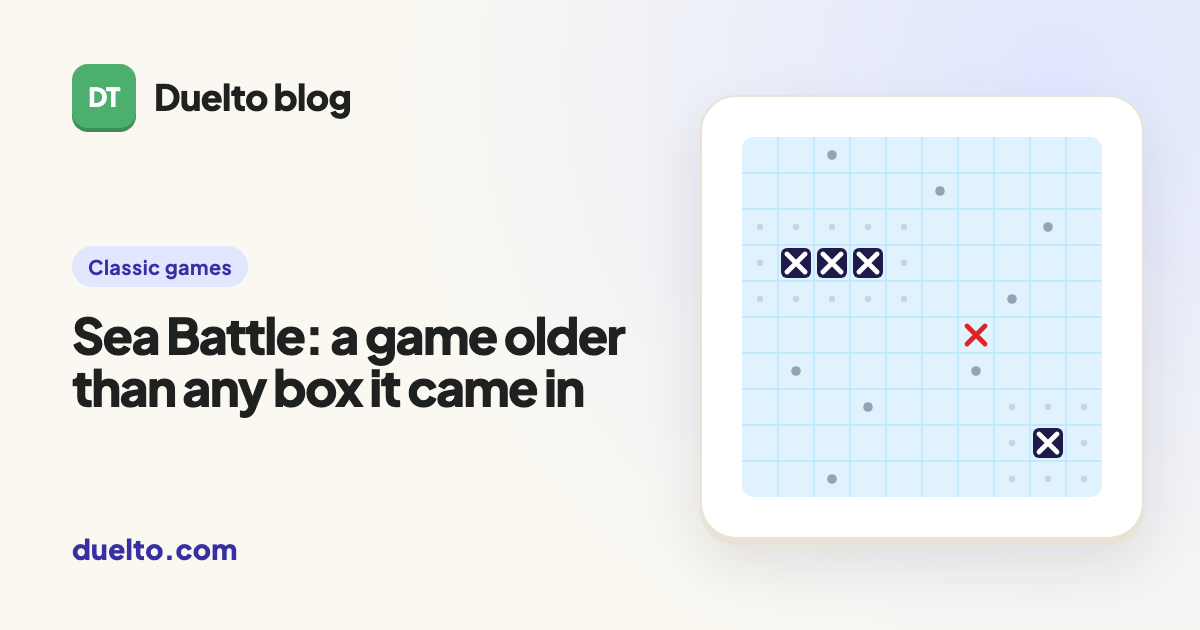
Sea Battle is the game played on squared paper when a lesson drags on: two grids of 10×10, a fleet hidden on each, and shots called out by letter and number. It was played long before anyone sold it, and nobody knows who drew the first grid.
This article follows the trail that can be traced: stories from before the First World War, the printed pads of the 1930s, the plastic and electronic versions that came later, and the names, fleets and variants the game has around the world.
Before the First World War
The early history is a story told more than a record kept. In 1931 an American newspaper, writing about a new boxed version, said the game had been played by Russian officers before the First World War. A diary entry by the Russian poet Ryurik Ivnev, from 1907, is cited as the earliest written mention of it being played.
Some writers also compare it with Basilinda, a game published by E. I. Horsman in 1890. None of this settles where the game began: a game drawn on paper and thrown away leaves few traces. What is clear is that by 1931 it was known well enough to sell.
Printed pads in the 1930s
The first commercial version was Salvo, published in the United States in 1931 by the Starex company. Others followed in the 1930s and 1940s, among them Milton Bradley’s Broadsides: A Game of Naval Strategy. All of them were pads of paper with the grids already printed: the same game as on squared paper, with the drawing done for you.
Salvo also gave its name to the best-known variant, in which a player fires several shots in one turn, one for each of their ships still afloat. Losing a ship then costs firepower as well as cells, and a game can turn quickly.
Plastic ships, a microchip and a screen
In 1967 Milton Bradley published a version with plastic pegboards and small plastic ships, the box many people picture today. In 1977 the same company released an electronic version, one of the first toys built around a microprocessor.
The game moved to computers early too. A version was released for the Compucolor home computer in 1979, which makes Sea Battle one of the earliest games produced for computers. Versions for home computers, consoles and phones followed.
One game, many names
The game has its own name in almost every language, and most of them describe what happens on the paper:
- Russian: Morskoy boy, “sea battle”, and the same in Ukrainian and Azerbaijani. Sea Battle, the name Duelto uses in English, is its translation.
- German: Schiffe versenken, “sinking ships”; Dutch: Zeeslag, “sea battle”; Polish: Statki, “ships”.
- French, Italian and Portuguese: bataille navale, battaglia navale, batalha naval, “naval battle”. Spanish has Batalla naval too, and Hundir la flota, “sink the fleet”.
- Turkish: Amiral battı, “the admiral has sunk”.
Two fleets and one rule that matters
On paper in Eastern Europe and the former Soviet Union, the usual fleet has ten ships: one of four cells, two of three, three of two and four of one, twenty cells in all on a 10×10 grid. Ships may not touch, not even at a corner. The American boxed game, in the rules Milton Bradley printed in 1990, has five longer ships, of 5, 4, 3, 3 and 2 squares.
The rule against touching changes the game more than the ship sizes do. Every cell around a sunk ship is water, and so are the four corners of every hit, so a player who knows the rule wastes fewer shots. That is where our guide how to win at Sea Battle starts.
Even the labels differ. English-speaking players mark the columns A to J. Russian players use the letters А to К, skipping Й, and some label the columns with a ten-letter word in which no letter repeats, such as республика, “republic”.
Variants to try
Once the usual game holds no surprises, change one rule:
- Salvo: each turn, one shot for every one of your ships still afloat. Losing a ship costs firepower too.
- Silent sinking: the player under fire says “hit” but never “sunk”, so the shooter has to work out when a ship is finished.
- A ship on the move: every fourth or fifth turn, a player may move one of their ships to a new place.
- Mines and minesweepers: some Russian-language rule sets add mines to the grid and minesweepers to the fleet.
- A bigger sea: a 15×15 grid with a ship of five cells added.
Play it without paper
Duelto plays the paper version: a 10×10 grid, ten ships from four cells down to one, and no touching. You can play Sea Battle without an account against the bot at three levels, and the Random button places a legal fleet in one tap. With an account, Sea Battle online is rated, and your fleet stays on the server, out of the other player’s reach, until the game ends.