Strategy games for the maths classroom
For teachers · · 4 min read
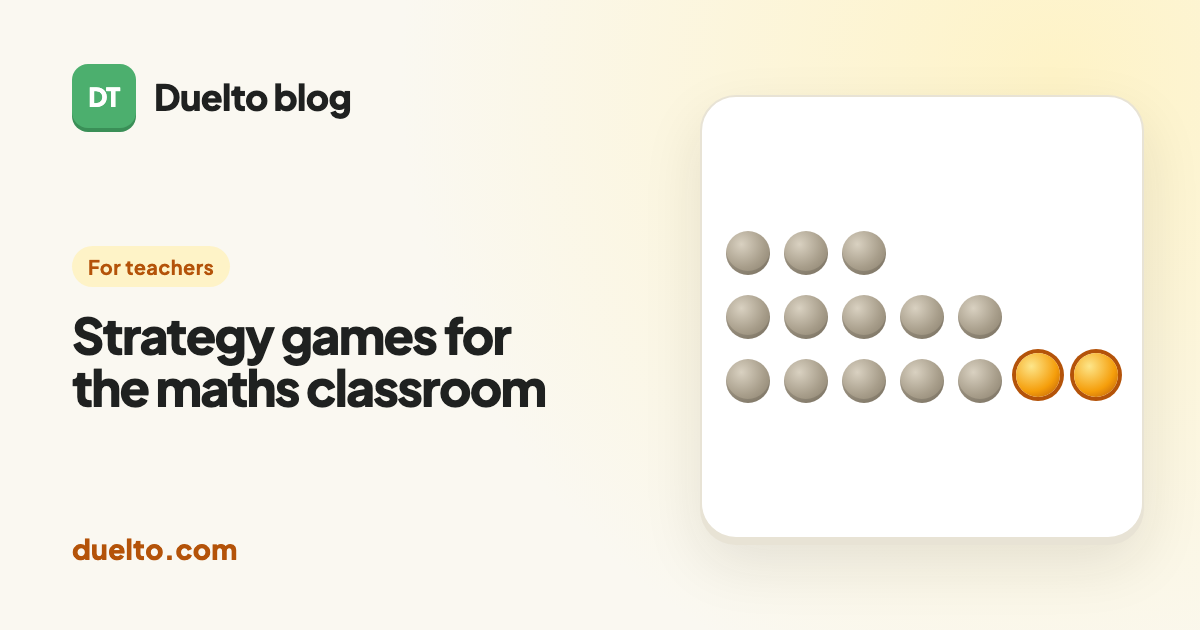
A good strategy game is a maths problem that pupils want to solve. Two players, no dice and no hidden cards: when you lose, there is a reason, and finding it is the same work as a proof. Spot a pattern, guess a rule, test it, explain why it holds.
Here are four games that fit into a lesson, from age 6 to 14, with the idea each one teaches and an activity built around it. All four work on paper, and all four can be played in the browser on Duelto with no accounts and no sign-up.
The 21 game: multiples and remainders
From age 8. Twenty-one stones, two players, and each turn you take one, two or three. Whoever takes the last stone wins. Leave a multiple of 4 after every move and you cannot lose. Finding that rule is the lesson.
The activity: in pairs, with counters or marks on paper, play small piles first, from 5 up to 12 stones. For each pile, pupils record whether the player to move could always win. The table shows the pattern before anyone can say why: 8 and 12 are lost for the player to move, like 4. Then the class predicts the winning first move from 21, and tests it.
To go further, change the limit to one to four stones and ask for a prediction before anyone plays: the losing piles become the multiples of 5. From about 12, classic Nim with several piles brings in binary numbers. The whole explanation is in how to always win the 21 game.
Tic-tac-toe: symmetry and checking every case
From age 6. Everyone already knows the rules, which makes it the right first game for reasoning about every possibility. There are nine first moves, but turning and reflecting the board shows that only three are really different: the centre, a corner and an edge.
The activity: the first player takes a corner. Groups try all eight replies and sort them into the ones that lose against best play and the ones that do not. Only the centre is safe, and a group that can show why has done a complete case analysis. With perfect play every game is a draw; how to win at tic-tac-toe shows how to beat anyone who is not perfect.
Four in a Row: counting lines
From age 6, and from 10 against the hardest bot. Seven columns, six rows, and each disc falls to the lowest free cell; four in a line wins. Why do strong players start in the middle column? Counting gives the answer.
The activity: count every possible line of four on the board. Pupils usually split the work: 24 across, 21 up and 12 diagonals in each direction, 69 in all. Then each group takes one row, counts the lines through each of its cells and writes the numbers on a printed grid. The bottom corner comes out at 3, the middle cells of the board at 13, and the reason for the first move is there on the page.
Older pupils can go on to odd and even rows, the idea behind most wins late in a game, explained in how to win at Four in a Row.
Dots and boxes: formulas and parity
From age 8 on the smallest board. Players take turns joining two neighbouring dots; whoever closes a box claims it and draws again. The game holds two lessons at different levels.
For younger pupils: how many dots and lines does a board have? A board of 3×3 boxes has 16 dots and 24 lines, 4×4 has 25 and 40, 5×5 has 36 and 60. Ask for the rule for a board of n by n boxes: (n + 1)² dots and 2n(n + 1) lines.
From about 12, the long chain rule: add the number of dots to the number of long chains expected at the end, and the first player wants the total to be even. Odd and even decide who wins long before the game is over; the Dots and Boxes strategy guide shows why with nothing harder than counting turns.
Playing them in class
Each game opens in the browser without an account: the 21 game and Nim, tic-tac-toe, Four in a Row and dots and boxes. There is nothing to install, and no name or email is asked for; we keep only an anonymous count of games played. There are no ads, no chat and no messages.
Two ways of playing suit a classroom:
- Two players on one screen: one device per pair, and the pair talk through every move.
- Against the bot, at three levels: Easy to learn the rules, Hard as the class challenge. On a projector, the class can vote on each move against Hard.
- In Nim, dots and boxes and Four in a Row, the Hint button suggests a move, and a game lost to the bot ends by showing the move that decided it.
A 40-minute lesson with the 21 game
One way to spend a lesson on the first game, from rules to rule:
- 5 minutes: the rules, and one game against the bot on the projector.
- 15 minutes: pairs play piles of 5 to 12 with counters and record who wins each one.
- 10 minutes: the class puts the results together and states a rule.
- 10 minutes: pairs test the rule against the Hard bot on 21. It never misses a winning move, so a pair that beats it has found the rule. Keep the Hint button for the end, because in the 21 game it gives the answer away.
Accounts, only if you want them
Rated games against other people need an account, and the games above do not. Accounts are open from age 8. Under 13, the sign-up asks for a parent's email, and the account starts only once the parent opens the confirmation link.