How to win at Mancala
Strategy · · 4 min read
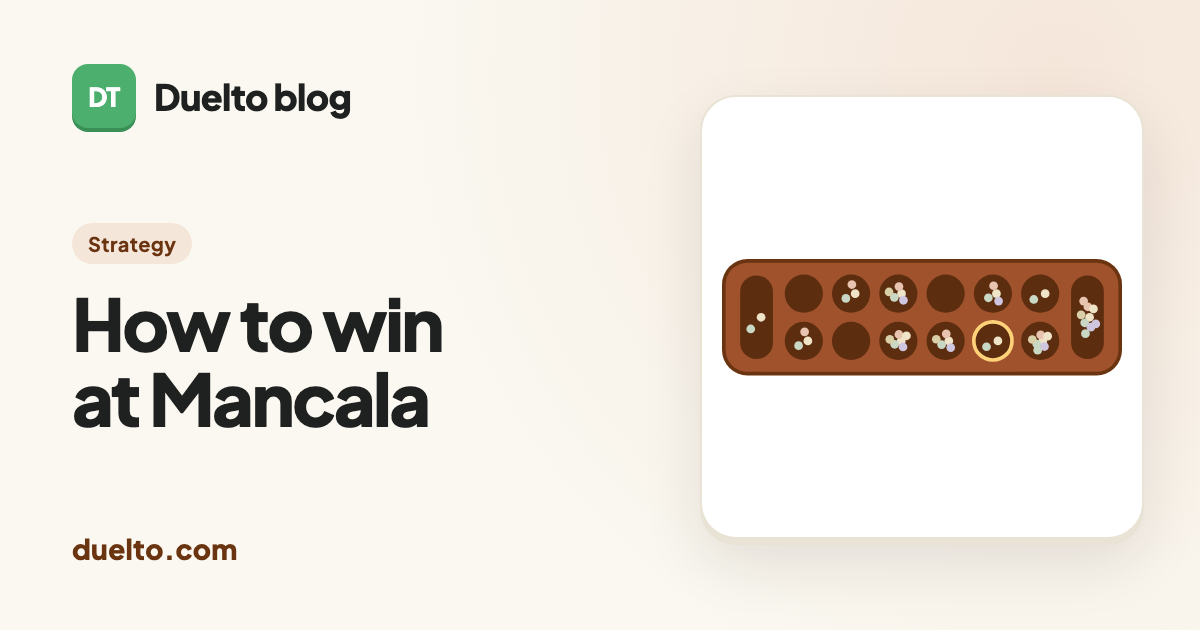
Mancala looks gentle: you pick up seeds and drop them one by one. But it has no dice and no hidden cards, so every game is won by counting. Before you touch a pit you can know exactly where its last seed will land, and that one fact decides whether you move again, take a pile from the other side, or hand the other player a gift.
This guide uses the most common rules, often called Kalah: six pits a side, four seeds in each, a store at each player's right. We tested each idea below by letting the computer play 200 games at a time, each side moving first in half of them, and counting what happened.
Count before you sow
A pit with n seeds drops its last seed n places along. So a pit that is as many places from your store as it holds seeds ends in your store, and you move again. At the start, the third pit from the left holds four seeds and sits four places from the store: that is the extra turn on the first move.
This one habit already wins most games against someone who does not count. A player who took an extra turn whenever there was one, and otherwise played at random, beat a random player in 170 of 200 games, with 10 draws.
Play the extra turn nearest your store first
Often two or three pits give an extra turn at once. Play the one nearest your store first. It drops its seeds only into the store, or close to it, so the other pits still line up afterwards. A pit further away drops a seed into every pit it passes, and each of those now holds one seed too many.
We tested it directly: two players who both always took extra turns, one starting with the pit nearest the store and one with the furthest. Nearest first won 124 games, lost 66 and drew 10.
Captures decide games
If your last seed lands in an empty pit on your side and the pit opposite has seeds, all of them go to your store, with your seed. One capture can be worth ten seeds or more. In 183 games between random players that had a winner and where the two sides captured different amounts, the side that captured more won 165.
A pile of exactly 13 seeds is a special trap: it goes all the way round, skips the other player's store, and its last seed lands back in the pit it came from, which is now empty. The pit opposite has just received a seed, so a 13 always captures.
Guard your full pits
Grabbing every capture is not enough on its own. A player who always took the biggest capture on offer beat random moves in 138 of 200 games, fewer than the player who simply took extra turns. Against the Medium bot, which also counts the best reply before it moves, the capture-grabber won only 4 of 200, with 1 draw.
Before every move, look across the board. A full pit of yours opposite an empty pit of the other player is a target: they need only one move that ends in that empty pit. You can move the full pit away, or fill the empty pit across from it with one of your own seeds.
The end of the game
The game stops as soon as one side has no seeds left. The seeds still on the other side go to that side's owner. So when you are ahead, a side that runs dry can be a good thing: it ends the game before the other player catches up. When you are behind, keep seeds on your side and keep the game going.
Count the stores near the end. With 48 seeds in all, a store with 25 has already won, whatever happens to the rest.
Who moves first
Between strong players the first move matters. Computer analyses have shown that the standard game with four seeds a pit is a win for the first player when neither side makes a mistake. Our Hard bot opens the way you would expect from the counting above: the third pit for an extra turn, then the pit next to its store.
Between two copies of the Hard bot, the player who moved first won 46 of the 73 games that had a winner. That is why online games on Duelto draw who starts at random.
What the numbers say
Each line is 200 games with four seeds a pit, each side moving first in half of them: wins, draws and losses for the first player named.
- Taking every extra turn, otherwise random, against random moves: 170, 10, 20.
- Taking the extra turn nearest the store first, against the furthest first: 124, 10, 66.
- Taking the biggest capture, otherwise random, against random moves: 138, 7, 55.
- The Medium bot (counts the best reply), against taking the biggest capture: 195, 1, 4.
- The Medium bot, against the Easy bot (takes extra turns, otherwise random): 172, 6, 22.
- The Hard bot (searches many moves ahead), against the Medium bot, in 100 games: 98, 1, 1.
How to practise
Play Mancala without an account against the bot. Easy takes extra turns, Medium also guards against captures, and Hard searches many moves ahead. Three seeds a pit makes a quicker game for learning. Pressing a pit shows where its last seed will land, the Hint button marks a good pit and says why, and after a loss the game shows the key moment, such as a big capture. When you are ready for people, Mancala online is rated, with 2½ minutes each.