Games like Stratego: the hidden-piece family
Board games ·
Most board games show you everything. Chess hides nothing; the whole contest is in what you can calculate. Stratego is built on the opposite idea: you know exactly what your own pieces are, and nothing about your opponent’s until they fight.
That idea is older than Stratego and has spread into several games. If what you like is the bluffing, the scouting and the moment a piece is revealed, these are the games that share it.
What makes a hidden-piece game
The games in this family share a few ingredients, and they are worth naming because they are what you are really looking for:
- Hidden identities: each side sees its own pieces, and only the backs of the other side’s.
- A setup phase: you arrange your army before play begins, and a good setup is half the game.
- Reveal by contact: a piece’s identity comes out when it fights, so information is won and lost like material.
- Bluffing: a piece that moves with confidence may be strong, or may want you to think so.
Stratego and where it came from
Stratego is played on a ten-by-ten board with two lakes in the middle. Each player has forty pieces with military ranks, plus bombs and a flag; a higher rank beats a lower one, and the goal is to capture the enemy flag. It was first published in the Netherlands in the 1940s and has been in print ever since.
It had a clear ancestor. L’Attaque, patented in France by Hermance Edan in 1908, already had two armies of hidden, ranked pieces facing each other across a board, with the flag as the target. Stratego refined the idea rather than inventing it.
Its relatives
Other games reached the same idea from different directions:
- Luzhanqi, or “land battle chess”, is a Chinese game in the same spirit: ranked pieces set up face down, with a third person acting as referee so neither player sees what they captured.
- Banqi, or “dark chess”, uses the pieces of Chinese chess, placed face down on half the board. Players flip pieces as a move, so hidden information runs through the whole game rather than just the setup.
- Kriegspiel is a chess variant where you cannot see your opponent’s pieces at all. A referee tells each player only whether their move was legal and what was captured.
RPS Board: the idea with rock paper scissors instead of ranks
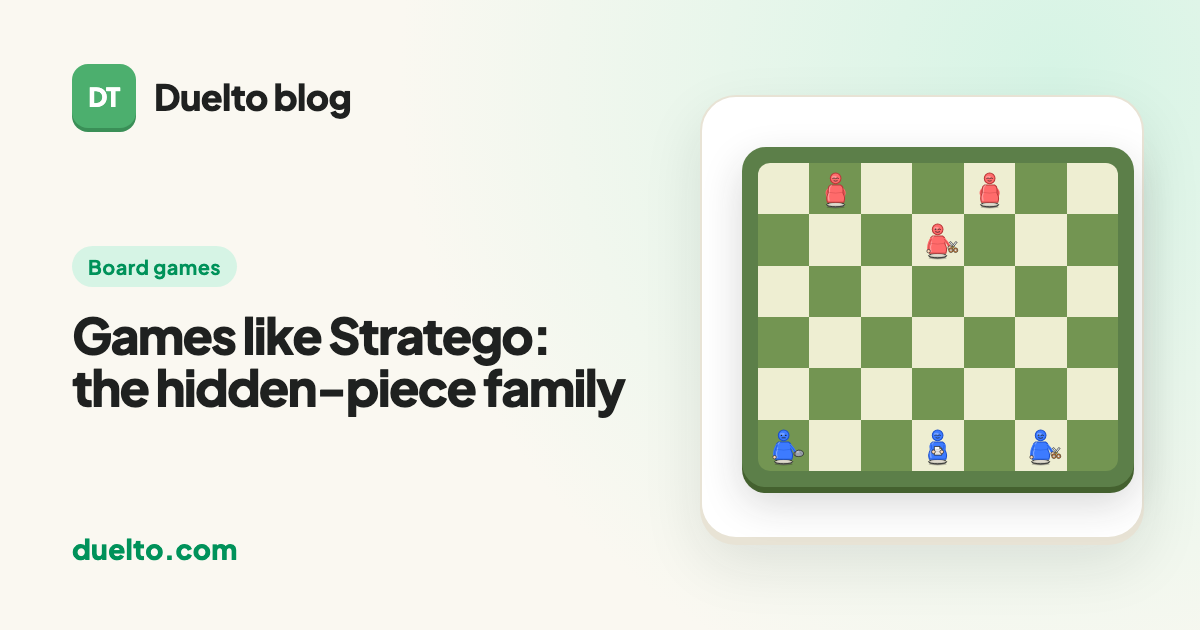
RPS Board is Duelto’s take on the family, built for a match of a few minutes rather than an evening. The board is seven columns by six rows. Each side has fourteen hidden pieces: four rocks, four papers, four scissors, a flag and a trap. You set them up in your back two rows, shuffling or swapping them before the match begins.
The difference is in how fights are decided. There are no ranks: rock beats scissors, scissors beats paper, paper beats rock. That makes the strength of a piece circular — every piece that can attack can also be beaten — so there is no untouchable top piece to hunt down or protect. When two identical pieces meet, both players secretly pick rock, paper or scissors, and the winner becomes the sign it played.
The trap never moves and destroys anything that attacks it. The flag can move, but loses to any attacker, and losing it loses the match. Each player has a five-minute clock for the whole game.
What carries over from Stratego
If you already play Stratego, most of your instincts transfer:
- The corner is the obvious place for a flag, which is why a strong opponent looks there first.
- A trap beside the flag, or on the natural path to it, works like a bomb does.
- A piece that has fought is known for the rest of the game; keep your unrevealed pieces as the threats your opponent cannot price.
- Moving a piece confidently toward the enemy says something about it — whether or not it is true.
Where it differs
The small board and short clock change the pace: there is less room to hide and less time to think, so setups get tested within the first minute. And because fights between identical pieces go to a hidden rock paper scissors pick, even a perfect read of the board leaves a moment where you have to read the person. Our guide on how to win at rock paper scissors is, in that sense, also an RPS Board guide.
Stratego is a trademark of its owners; Duelto is not connected to them. RPS Board is its own game, in the same family.